MACHINING AND POLISHING
CNC wheel refinishing
Taking a thin layer off on the lathe restores an even circle and a flat bead seat, while polishing leaves clean bare metal.
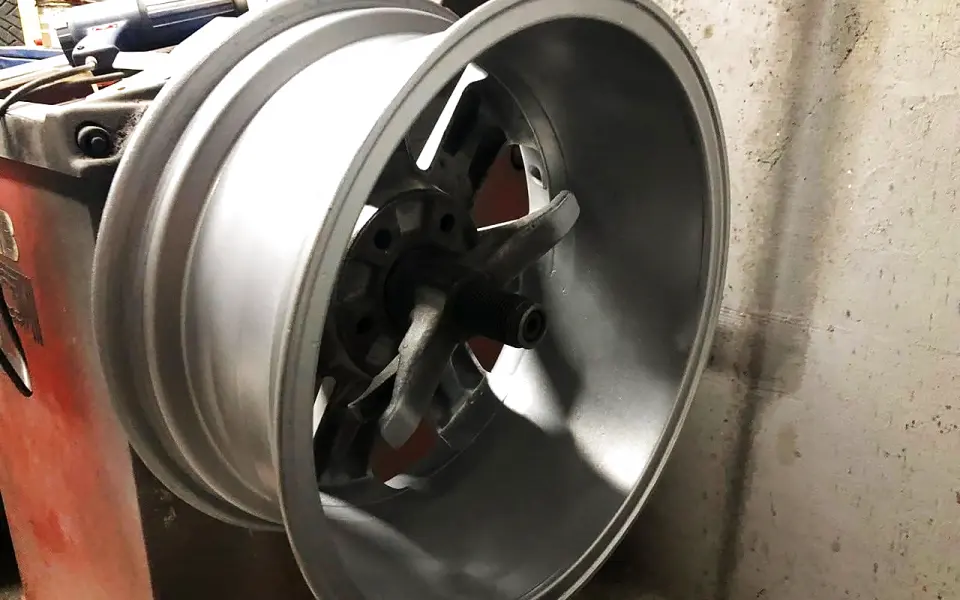
What happens on the lathe
What people search for as CNC wheel refinishing is done here on a dedicated wheel lathe. The rim is centred, spun, and the tool takes a thin, even layer off all the way round. The surface gets its true circle back, without the high and low spots you feel while driving.
Machining comes after the mechanical work. A welded area is left with surplus metal and a straightened edge with unevenness, and both are only taken down on the machine. That is why hardly any serious wheel repair finishes without this step, whatever the material.
Polishing the lip is a job in its own right. The outer edge is sanded through several grades and then polished until it carries the shine of bare metal, which is often combined with painting the rest of the wheel in a darker tone. The result is a sharp line between bright lip and coated body.
Machining is done when
- Surplus metal is left after welding
- The bead seat is uneven and lets air out
- The rim edge is scarred right round
- Old lacquer has to come off before painting
- The lip is being prepared for a mirror polish
What machining solves
Four reasons a wheel goes onto the lathe, either after a repair or purely for the way it looks.
Restoring a true circle
Small deviations remain after straightening and welding. Taking a thin layer off right round gives the rim an even circle again and a calm rotation.
A flat bead seat
The sealing face has to be flat to hold air. If corrosion has eaten it or a weld has left it uneven, it is machined back to a clean plane.
Removing the old coat
Before painting, the old lacquer and deposits are cut off the front face, so new colour lies on prepared metal instead of a coat that is already lifting.
Polishing the lip
The outer edge is sanded through several grades and polished to a metal shine. The result is a pronounced detail that reads best on a darker wheel.
How the lathe work runs
From centring to the final check, all in one and the same clamping, so accuracy is not lost along the way.
Centring the wheel
The rim is clamped on the machine and centred, because any error in the clamping is carried into the whole cut and shows up at the end.
First pass
The tool takes the smallest layer that reaches the full surface. The aim is to remove as little metal as possible while gaining an even circle.
Finishing pass
After the roughing cut comes the fine one, which leaves an even tool pattern and a surface ready for polishing or for paint preparation.
Check and finish
The result is watched while spinning and felt by hand right round. The wheel then goes to polishing, into paint preparation, or straight to tyre fitting.
How much metal may be taken off
Machining always means the wheel becomes slightly thinner where it is cut, so only what is necessary is removed and not a gram more. That is why the work goes in thin passes with a constant check on whether the surface is already clean all the way round or needs one more cut.
If a flat surface would require too much metal to come off, the job is not done. The same applies to wheels whose front face has already been cut deeply in the past. In such a case another solution is looked for, or the work is declined, because safety comes before appearance.
Questions about wheel refinishing
What does CNC wheel refinishing actually mean?
The term usually describes taking a thin layer of metal off while the wheel turns on a machine, which restores a true circle and an even surface. Here that is done on a dedicated wheel lathe, with the rim centred before every single pass.
Does machining remove scratches from the rim edge?
Yes, if the scratches sit within the layer that comes off anyway. Surface marks from a kerb disappear on the first pass. Deeper gouges need metal added by welding first, because otherwise they would have to be cut out too deeply and the wheel would be thinned needlessly.
Do the tool marks stay visible on the wheel?
A fine cut leaves an even circular pattern that counts as part of the look on wheels finished this way. If you want a smooth surface, the lip is polished further and the rest of the wheel is prepared and painted, after which the machining trace is no longer visible.
Can a steel wheel be machined as well?
It can. A steel rim is clamped and cut in the same way, most often to level the bead seat or to clean corrosion off the sealing face. The harder material means slower passes, but the outcome is the same: a flat, clean surface that holds air.
Is machining done without welding first?
It is, when the wheel is only scratched or when it is being prepared for new colour. Welding is only needed if metal is missing or a crack is present, because neither of those can be solved by taking a layer off, however many passes are run.
What do you get from polishing the lip?
The outer edge gains the shine of bare metal and a clear boundary against the painted part of the wheel. The procedure runs from coarser sanding to ever finer grades and ends with polishing. The effect is strongest when the rest of the wheel is in a dark tone.
Before and after machining
Machining rarely stands alone: straightening and welding come before it, surface preparation and tyre fitting after.
Welding and crack repair
Cracks, breaks, holes in the bead seat and missing chunks of metal. The area is welded through its full thickness and machined back to the wheel's original line.
More on thisStraightening buckled wheels
A wheel that hops, shakes the steering or has gone oval after a pothole is pressed back into a true circle in small stages, with the metal checked as it goes.
More on thisPreparation and wheel painting
Old lacquer and corrosion come off down to sound metal, then primer and topcoat go on in a colour agreed before any work starts.
More on thisTyre fitting and balancing
Tyres off and back on, new rubber fitted, seasonal changeovers and wheel balancing so the steering stays calm out on the open road.
More on thisBrake caliper painting
Rusty calipers are cleaned back to metal and coated in heat-resistant paint, so the gap between the spokes shows a tidy detail instead of corrosion.
More on thisNeed a wheel put back true?
Send a picture of the front face and of the bead seat, and we will agree what the lathe can do for it.