WELDING AND REPAIR
Wheel welding
A crack by the bead seat, a broken edge or a hole letting air escape: metal is welded in and brought back to shape.
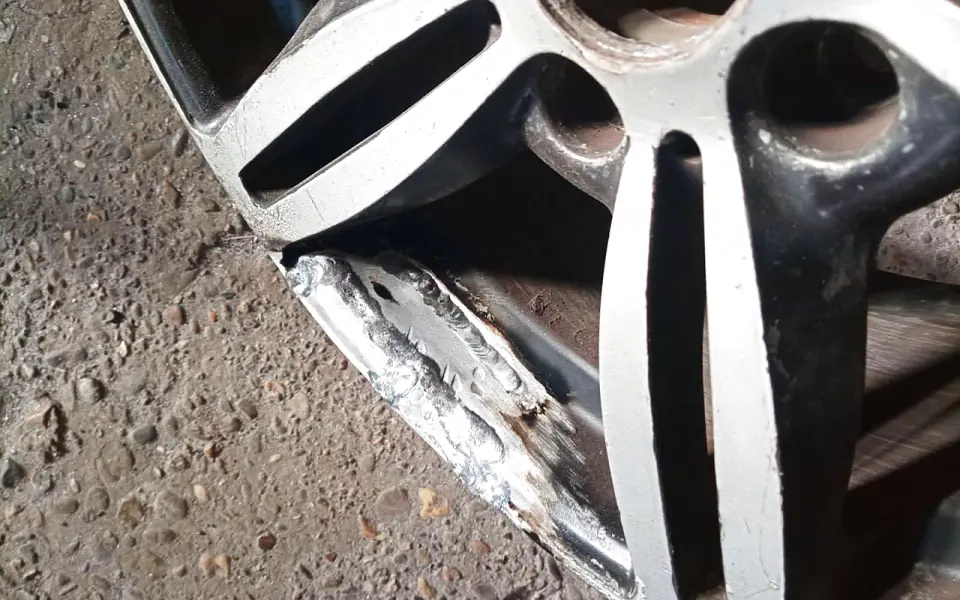
When aluminium cracks
Aluminium does not give way slowly. When a wheel hits a sharp-edged hole, the metal simply splits at its thinnest point, most often along the bead seat where the tyre sits. Such a break shows as a fine line, and you notice it because the tyre is down on pressure by morning.
Welding starts with cleaning. The area is taken back to sound metal and prepared, then filler is laid in over several passes with careful heat control so the rim does not distort. Where an edge is broken away, extra material is left standing and removed afterwards by machining.
Not every crack can be welded. If the break runs through the wheel disc, through the root of a spoke or through the area around the bolt holes, the repair is not carried out, because that is the part carrying the whole wheel. In that case you hear it immediately and the wheel is left alone rather than risked.
Most commonly welded
- Crack by the bead seat that lets the tyre down
- Torn-off piece of the outer rim edge
- Corrosion hole through the sealing face
- Break at the disc to barrel joint on a steel rim
- Several small cracks in the same part of the barrel
What gets welded
Four types of damage that most often end up at the welder, on aluminium and on steel rims alike.
Cracks along the bead seat
Fine lines that let the air out. The area is ground into a groove, welded through the full thickness and levelled, so the seat seals again all the way round.
Missing piece of the rim edge
Where an impact has torn part of the edge away, metal is built up layer by layer and then cut back on the lathe to the line the wheel keeps everywhere else.
Holes and pierced spots
A hole made by corrosion or impact is cleaned back to sound metal and closed with weld. Where the surrounding metal is thin, filler is added over a wider area.
Breaks on steel rims
Steel wheels are welded conventionally, usually at the joint between disc and barrel or on the edge. The seam is then cleaned, levelled and prepared for paint.
How the welding goes
The sequence is always the same, whether it is a hairline crack or a torn-off piece of the rim edge.
Tyre off and cleaning
The tyre comes off the wheel and the damaged area is cleaned of paint, grease and oxide. Welding is done on bare, sound metal only, never over a coating.
Preparing the crack
The crack is traced to its end and ground into a groove so the filler reaches through the full thickness. That avoids a seam that only holds on the surface.
Building up the weld
Filler is laid in over several passes with the heat going into the wheel kept under control. Where a piece is missing, extra material is left on purpose.
Machining and checking
The excess is taken back on the lathe and the grinder to the shape the wheel has on its undamaged side. Finally the tyre goes back on and the wheel is balanced.
When welding makes sense and when it does not
The limit is not the length of the crack but where it sits. The barrel and the bead seat can be repaired and machined afterwards, since they are brought back into a true circle anyway. That is why long breaks and sizeable missing pieces are still taken on in that part of the wheel.
The wheel disc, the area around the bolt holes and the root of the spokes are a different matter. Loads there change constantly while driving and a weld is no reliable answer. The assessment is only made once the tyre is off, because a crack often runs further on the inside than it looks.
Questions about wheel welding
Is a welded wheel still safe to drive on?
If the break is in the barrel or the bead seat and the weld goes through the full thickness of the metal, the wheel behaves as it did before the damage. That is why the welded area is always machined afterwards and the assembly balanced. Breaks in safety-critical zones are not repaired at all.
Can a wheel with a missing piece be welded?
It can, as long as the missing part belongs to the barrel or the outer edge. Metal is built up in several layers, left slightly proud, and then machined down until the original line of the wheel returns. A close-up photograph shows best how much is gone.
Is the wheel or the tyre losing the air?
If the tyre goes down slowly and has no puncture in it, the rim is usually the reason: a crack along the bead seat, or corrosion that has eaten into the sealing face. That is established once the tyre is off and the wheel is checked right round, on both sides.
What does a wheel look like after welding?
Once machined, the welded area no longer differs in shape from the rest of the wheel. The trace can be made out as a difference in the tone of the metal if the rim is left unpainted. If preparation and paint follow, the repair is no longer visible at all.
Are aluminium and steel wheels welded the same way?
No. Aluminium needs a different procedure and careful heat control, because it distorts easily and the oxide layer has to be removed right before the weld. Steel takes more heat and is welded conventionally. Both procedures are carried out in the same workshop.
Should I bring the wheel without the tyre for welding?
There is no need. The tyre is taken off here on the machine and refitted after the job. What matters more is telling us whether the wheel loses air and where you noticed the damage, because that speeds up finding the full length of the crack, including where it continues inside.
What usually goes with welding
A welded area nearly always needs machining, and a wheel that cracked under impact is generally a little bent as well.
Straightening buckled wheels
A wheel that hops, shakes the steering or has gone oval after a pothole is pressed back into a true circle in small stages, with the metal checked as it goes.
More on thisCNC refinishing and lip polishing
Taking a thin layer off on the lathe restores an even circle and a flat bead seat, while polishing gives the outer lip the shine of bare metal.
More on thisPreparation and wheel painting
Old lacquer and corrosion come off down to sound metal, then primer and topcoat go on in a colour agreed before any work starts.
More on thisTyre fitting and balancing
Tyres off and back on, new rubber fitted, seasonal changeovers and wheel balancing so the steering stays calm out on the open road.
More on thisBrake caliper painting
Rusty calipers are cleaned back to metal and coated in heat-resistant paint, so the gap between the spokes shows a tidy detail instead of corrosion.
More on thisCracked wheel? Send a picture
A close photograph of the damage is enough for a first opinion on whether the break can be welded safely.